
Reporting and Ratings
GRI 2-3
Joint Stock Company “Uztransgaz” (hereinafter in the Report referred to as the Company, or the Organization) publishes its fifth integrated annual report, disclosing the Company’s operational and financial performance indicators. The previous Report was published in November 2024 (covering the reporting period from 1 January to 31 December 2023).
The purpose of this Report is to ensure transparency and openness in the Company’s activities, as well as to provide stakeholders with balanced and objective information on the Company’s approaches to sustainable development, social, economic, and environmental responsibility.
The Company follows an annual reporting cycle, covering the period from 1 January to 31 December 2024, and also includes a description of plans for 2025. The financial reporting period coincides with the calendar year—from 1 January to 31 December.
This Report presents consolidated information on the Executive Management of JSC “Uztransgaz,” its structural divisions, and subsidiaries for 2024. The financial position and production results of the Company are presented based on consolidated data, prepared with the support of the relevant departments and divisions.
The Report is prepared in accordance with the requirements of the GRI Standards 2021 (hereinafter referred to as GRI) and SASB Standards — Oil & Gas Midstream (hereinafter referred to as SASB). To ensure comparability and analysis of key performance indicators, information in the Report is provided for several reporting periods.
The Sustainability Report of JSC “Uztransgaz” is approved by order of the Chairperson of the Management Board and communicated to stakeholders by publication in Russian and English on the corporate website: https://www.utg.uz/en/.
Report Preparation Process
Stakeholder Engagement
GRI 3-1, 2-25, 2-26
To achieve the Company’s strategic objectives, effective engagement with stakeholders is essential. JSC “Uztransgaz” builds its relationships with all stakeholders based on trust, openness, and mutually beneficial cooperation, which allows the Company to understand their interests and meet expectations. JSC “Uztransgaz” consistently takes steps to establish dialogue, long-term cooperation, and stakeholder relationship management.
Furthermore, relationships between JSC “Uztransgaz” and structural divisions working within the Company’s area of responsibility are based on their mutual interest in ensuring the safety of people, including Company employees and contractors, as well as other external stakeholder groups (such as the public, visitors, etc.) located in the work area. The Company’s stakeholder engagement process, built on best practices, enables the timely identification and assessment of stakeholder interests and proposals through various dialogues and other activities aimed at improving interaction.
Handling Inquiries
The Company regularly informs and maintains open dialogue with all stakeholders on matters related to the integrated management system. Special attention is paid to feedback from employees, as they are able to promptly report issues and operational risks. To facilitate this, the Company operates a hotline and a communication channel on the corporate portal.
We also focus on communication with external stakeholders. For this purpose, JSC “Uztransgaz” has a dedicated service for handling inquiries, complaints, and suggestions. Submissions are accepted by mail and email. In addition to written appeals, the Company operates a hotline and a dedicated phone for inquiries, holds open reception days for individuals and legal entities with members of the Executive Management, and organizes outreach events to ensure that individuals and legal entities from remote regions can directly address complaints and suggestions. Given the Company’s line of business, special attention is paid to the thorough review of inquiries in order to resolve conflicts, clarify opportunities for assistance and support, or provide other responses. The majority of inquiries come from individuals who are either Company employees or consumers of natural gas. In 2024, JSC “Uztransgaz,” its structural divisions, and subsidiaries received 2 299 inquiries. By the end of the reporting period, 1 917 inquiries were positively resolved, 356 received clarifications regarding the impossibility of providing support, and 26 inquiries remained under review.
Stakeholder Identification
The list of stakeholder groups whose opinions influenced the determination of material topics for the 2024 Report has not changed. The list is provided below:
| № | Interested party |
|---|---|
| 1 | Management and personnel |
| 2 | Shareholders |
| 3 | Subsidiaries and dependent organizations |
| 4 | Government agencies |
| 5 | Energy Industry |
| 6 | Trade Unions |
The selection of stakeholders for engagement by the Company was based on the following three principles:
- Engagement – the extent to which the stakeholder’s activities are connected with the activities of JSC “Uztransgaz.”
- Impact – the degree to which the stakeholder is able to influence the activities of JSC “Uztransgaz.”
- Materiality – the contribution that the stakeholder makes to the activities of JSC “Uztransgaz” through decisions directed toward the Company.
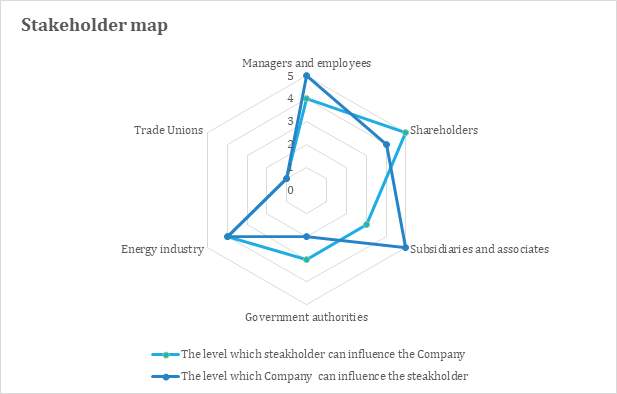
To identify, assess, and systematize stakeholder groups, the Company approved a Stakeholder Map reflecting the results of its stakeholder materiality assessment. In forming the Stakeholder Map, the Company evaluated both the degree of influence stakeholders have on the
Company and the exposure of stakeholders to the Company’s activities, using a five-point scale where 1 is the lowest influence and 5 is the highest, based on specific parameters of interaction. The approved Stakeholder Map is presented below:
As part of the preparation of this Sustainability Report, the Company engaged with all stakeholder groups by requesting information in order to obtain their consent to participate in the Materiality Survey for disclosure purposes.
Principles of Report Preparation
Preparing the Report, the Company followed the reporting principles of the GRI and SASB Standards, as well as the provisions of the Corporate Governance Code and other internal documents of the Organization. In particular, the following principles were applied in the preparation of this Report:
- Consideration of stakeholders’ views. The Company systematically engages with stakeholders, which allows the Report to reflect information relevant to them.
- Sustainable development context. The Report presents information on the Company’s production activities and the impact of these activities on the economy, society, and the country’s environment.
- Materiality. The Report addresses material topics, issues, and indicators of the Company’s economic, environmental, and social impact. The materiality of the information is determined based on the assessment by Company management of its performance for the reporting period and the views of stakeholders.
- Completeness. The Report provides information on all areas of Uztransgaz’s sustainable development activities during the reporting period, in accordance with GRI and SASB standards..
Material Topic Identification
GRI 3-1, 3-2
In accordance with the GRI and SASB Standards, the Company has identified material topics that are of the greatest importance to selected stakeholder groups and to the Company itself.
Approach to Materiality Determination
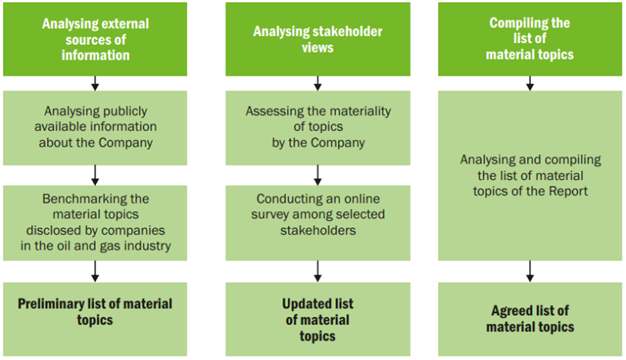
When developing the list of material topics, publicly available information about the Company was analyzed and a benchmarking review was conducted of material topics disclosed by companies in the transportation and oil and gas industries. The resulting preliminary list was adjusted by obtaining materiality assessments for each topic from Company management and through stakeholder survey responses. The online stakeholder survey was conducted among six stakeholder groups selected by the Company, using the digital platform “Google Forms.”
The process for compiling the list of material topics is presented below:
The final list of material topics is reflected in the Materiality Matrix presented below:
| Topic grouping | Topic number | Respondent ratings | Company vision | Topic titles |
|---|---|---|---|---|
| Economic topics | 1 | 4.3 | 3 | Economic performance |
| 2 | 4.1 | 4 | Procurement practices | |
| 3 | 4.0 | 4 | Anti-Corruption | |
| Environmental Topics | 4 | 4.6 | 4 | Energy |
| 5 | 3.9 | 4 | Water and Wastewater | |
| 6 | 4.5 | 4 | Emissions | |
| 7 | 3.8 | 4 | Waste | |
| Social Topics | 8 | 4 | 3 | Employment |
| 9 | 4.2 | 3 | Employee-Management Relations | |
| 10 | 4.2 | 4 | Health and Safety | |
| 11 | 4.1 | 4 | Training and Education | |
| 12 | 4 | 3 | Diversity and equal opportunities | |
| 13 | 4 | 3 | Non-discrimination |
Based on the analysis of stakeholder opinions and the Company’s materiality assessment, 13 material topics were identified, including topics from each category: economic, environmental, and social.
The consolidated list of material topics is presented below:
| № | GRI Index | Index Title |
|---|---|---|
| Economic Topics | ||
| 1 | GRI 201 | Economic Performance (2016) |
| 2 | GRI 204 | Procurement (2016) |
| 3 | GRI 205 | Anti-Corruption (2016) |
| Environmental Topics | ||
| 4 | GRI 302 | Energy (2016) |
| 5 | GRI 303 | Water and Effluents (2018) |
| 6 | GRI 305 | Emissions (2016) |
| 7 | GRI 306 | Effluents and Waste (2020) |
| Social Topics | ||
| 8 | GRI 401 | Employment (2016) |
| 9 | GRI 402 | Labor Management Relations (2016) |
| 10 | GRI 403 | Occupational Health and Safety (2018) |
| 11 | GRI 404 | Training and Education (2016) |
| 12 | GRI 405 | Diversity and Equal Opportunity (2016) |
| 13 | GRI 406 | Non-Discrimination (2016) |
Alongside the disclosure of information on identified material topics, this Report also includes information on issues recognized as material in accordance with the SASB Standard for the Natural Gas Midstream industry.
Report Topic Boundaries
GRI 2-2, 2-4
This integrated annual report discloses information on the activities of JSC “Uztransgaz,” all its structural divisions, and subsidiaries.
The Company’s operational and financial performance is reflected in the section “Economic Performance.” The Company’s financial statements for the current reporting period include consolidated financial indicators in accordance with IFRS.
In disclosing information for 2024, the Company practiced presenting key indicators in a three-year dynamic. Additionally, to provide a more comprehensive view, the Report includes events that occurred before the reporting period and development plans for various areas of the Company after 2024.
This Integrated Annual Report for 2024 defines the boundaries of topics for specific GRI and SASB indicators to ensure comprehensive disclosure in the respective sections. Certain indicators have their own boundaries due to the specific nature of some subsidiaries’ activities. For example, subsidiaries whose activities are not directly related to the production process may not have data for indicators such as “Natural gas consumption for process purging.” However, those indicators that are considered “universal” for all divisions of the Organization and its subsidiaries are subject to unified approaches in data collection and consolidation.
In the event of changes in the organizational structure of the Organization (acquisition, disposal, liquidation, or establishment of new structural units), the approach provides for the inclusion or exclusion of the structural unit in the consolidated reporting, familiarization with the Organization’s regulatory documents governing the reporting cycle and the procedure for collecting initial data, as well as obligations for reporting up to the end of the quarter in which the disposal/liquidation took place.
This Report is the fifth in the Company’s practice, and there have been no significant changes in the list of material topics or topic boundaries compared to previous reporting periods..
Feedback
A feedback form for readers is provided in the “Appendices” section of this Report. The purpose of including the questionnaire is to improve future reporting by obtaining feedback and suggestions from stakeholders. JSC “Uztransgaz” would appreciate the completion of the questionnaire to support the development of the Sustainability Report in subsequent periods.
Independent Assurance
GRI 2-5
The consolidated annual Report for 2024 underwent an independent external assurance procedure for sustainability-related information. The auditor’s conclusion is presented in Appendix 3.
The process of selecting an independent verifier was initiated by the Company’s Executive Management. The selection criteria included the independence of the verifying organization, its expertise in sustainability matters, experience in non-financial assurance, and its international reputation. This is the third time that the Sustainability Report has been assured, which can be considered an established and mandatory practice for the Company.