
Environmental responsibility
JSC “Uztransgaz” recognizes its responsibility for the environmental impact associated with the operation of gas transmission infrastructure. The Company is consistently committed to minimizing environmental risks, reducing emissions, using natural resources efficiently, and preventing environmental pollution.
Regular assessments are conducted to determine the scale and nature of the environmental impact, which helps define the Company’s contribution to the achievement of the United Nations Sustainable Development Goals (SDGs), with particular emphasis on:
- SDG 6 – sustainable water management and prevention of water pollution;
- SDG 7 – increased energy efficiency and sustainable energy supply;
- SDG 12 – responsible consumption and waste management;
- SDG 13 – climate action through reduction of greenhouse gas emissions.
Environmental safety is ensured in accordance with the legislation of the Republic of Uzbekistan and internal regulations of JSC “Uztransgaz”, which are developed in line with international standards and best practices.
To mitigate negative environmental impacts and address climate change, the Company implements activities in the following areas:
- reduction of gas losses during transmission and distribution;
- efficient use of energy resources;
- modernization of compressor stations;
- modernization of the gas transmission system;
- implementation of advanced gas distribution and metering technologies.
As of the reporting period, JSC “Uztransgaz” is implementing several climate action projects. One such project involves the modernization of the gas transmission system through the use of advanced technologies for hydrocarbon loss control. This project aims to enhance pipeline throughput capacity and ensure an adequate supply of natural gas to densely populated regions of the country.
The primary goals of JSC “Uztransgaz” in the field of energy management are to improve energy efficiency through the rational use of energy resources and the implementation and application of energy-saving technologies. The Company pays special attention to the gradual integration of renewable energy sources, steadily increasing their share in the total energy mix.
The Company's energy consumption structure includes various energy sources, with electricity and fuel being the primary ones. Given the energy-intensive nature of its production processes, identifying and implementing solutions to reduce energy consumption remains a key priority for the Company. In addition to its own consumption, the Company also provides electricity transmission services through its power networks to third-party consumers.
As of the reporting period, JSC “Uztransgaz” operates under an established procedure for energy planning and efficiency analysis, approved on 15 February 2021. This procedure sets a unified approach to conducting energy analyses, determining energy monitoring methods, and enhancing energy performance within the Energy Management System, in line with international ISO 50001 standards. It is also embedded within the Company’s integrated management system, which complies with ISO 9001 (Quality Management), ISO 14001 (Environmental Management), and ISO 45001 (Occupational Health and Safety Management).
According to this document, energy use and consumption are analyzed at the organizational, departmental, process, and sub-process levels. Reviews are conducted at least once a year or in the event of significant changes to equipment, systems, or processes. The analysis establishes baseline energy performance indicators, calculates forecast values, and defines data collection plans along with energy efficiency improvement measures. The baseline is set for a three-year period and is agreed upon with the relevant departments and units. Based on this baseline, projected energy consumption is calculated in accordance with production plans for the upcoming period. Any change in equipment, systems, or processes triggers a revision of the energy usage analysis.
This procedure is mandatory for all units falling within the scope of the energy management system and is based on ISO 50001:2018, the Company’s IMS manual, and related internal guidelines.
Energy is consumed primarily during gas transmission and underground storage. In 2024, total energy consumption amounted to 22 990 million MJ, with 95% of this volume attributed to gas transmission. Compared to 2023, overall energy consumption increased by 10.6% in 2024.
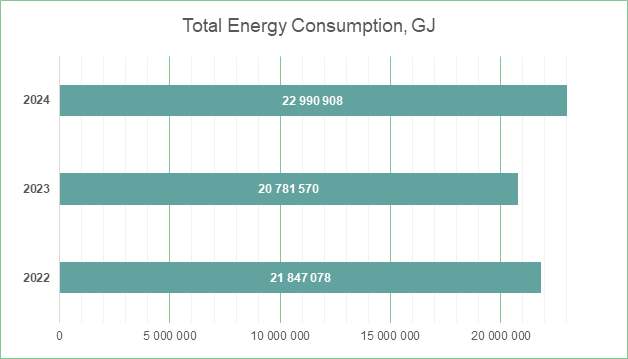
*Conversion factor: 1 kWh = 3.6 MJ; 1 Gcal = 4 187 MJ (according to IEA data). Energy carriers: 1 ton of diesel fuel = 43 000 TJ/Gg; 1 ton of gasoline = 44 300 TJ/Gg; 1 ton of LNG = 44 200 TJ/Gg; 1 ton of LPG = 47 300 TJ/Gg. Natural gas: 1 ton = 48 000 TJ/Gg (according to IPCC data).
The volume of electricity consumed in 2024 amounted to 1 669.6 thousand GJ, while the volume of thermal energy consumed totaled 70.3 thousand GJ. The more than 22% reduction in electricity consumption is attributed to the following factor:
- 1. 1. The decrease in electricity consumption is due to the implementation of organizational and technical measures aimed at energy savings at production facilities of JSC “Uztransgaz” in 2024.
The data on electricity and thermal energy consumption for the years 2022–2024 are presented below:
| Indicator | 2022* | 2023 | 2024 |
|---|---|---|---|
| Electricity, GJ | 2 415 358* | 2 167 116 | 1 669 575 |
| Thermal energy, GJ | 88 117 * | 69 047 | 70 328 |
The following non-renewable energy sources are used as fuel at the Company: diesel fuel, gasoline, fuel and process gases, liquefied petroleum gas (hereinafter – LPG), and compressed natural gas (hereinafter – CNG). These types of fuel are utilized for vehicle refueling, equipment purging, and in energy technology units.
In 2024, fuel consumption increased by an average of 14.5% compared to the previous year
The consumption of non-renewable fuels for the years 2022–2024 is presented below:
| Type of Fuel | 2022* | 2023 | 2024 |
|---|---|---|---|
| Diesel Fuel, GJ | 65949 | 66539 | 65470 |
| Gasoline, GJ | 6545 | 6686 | 4856 |
| Gaseous Fuel, GJ | 19227936 | 18432531 | 21126025 |
| Fuel Gas | 18514272 | 17603104 | 19879989 |
| Process Gas | 713664 | 829427 | 1246036 |
| LPG, GJ | 18162 | 17800 | 17759 |
| CNG, GJ | 24832 | 15134 | 23504 |
In order to enhance the energy efficiency of technological processes, it is essential to reduce natural gas consumption for internal needs and technological losses. It is important to note that these expenditures are directly influenced by the volume of transported gas, the amount of natural gas injected into the pipeline system, as well as the availability of material and technical resources.
Recognizing the environmental value and efficiency of using renewable energy sources, the Company has developed an action plan focused on the installation of solar water heaters, LED luminaires equipped with photovoltaic panels and motion sensors, and solar photovoltaic power stations for future periods. The main emphasis is placed on the deployment of solar photovoltaic stations (SPS). By the end of 2024, SPSs with a total capacity of 3.6 MW had been installed across the Company's units, which led to a significant increase in solar power generation.
The dynamics of electricity generation from SPSs are shown below:
| Indicator | 2023 | 2024 |
|---|---|---|
| Electricity generated from renewable energy sources, GJ | 6716,8 | 13390,89 |
Energy Intensity
The types of energy considered in calculating internal organizational energy intensity include electricity, thermal energy, and fuel. For the calculation of this ratio, the Company uses a single indicator that encompasses all types of its operations.
Energy intensity* for 2022–2024 is presented below:
| Indicator | 2022* | 2023 | 2024 |
|---|---|---|---|
| Energy Intensity, MJ/m³ | 0,47 | 0,45 | 0,61 |
In 2024, the energy consumption intensity amounted to 0.61 MJ/m³, which is 35% higher compared to the previous year. This increase is primarily attributed to the reduction in the volume of natural gas transported by the Company, particularly in the transit direction
Energy Consumption Reduction
The key strategic directions for improving energy efficiency and conservation within the Group include the modernization of technological equipment, the implementation of energy-saving technologies, the optimization of heat energy production and consumption, and the development of internal energy generation sources. The relevance of these projects is linked to the need to reduce natural gas consumption for internal needs and process losses, lower production energy intensity, and decrease greenhouse gas emissions.
The Company has adopted a schedule for the implementation of organizational and technical measures aimed at energy conservation through modernization and production upgrades for 2023–2025, specifically for JSC "Uztransgaz". This document outlines the total cost of the measures and their funding sources, which include foreign investments, loans, and the Company’s own funds.
Based on the conducted energy analysis, specific actions are developed to reduce energy consumption, ensure rational use of resources, and improve energy efficiency. In the development process, government decrees, sectoral energy saving programs, and internal documents such as the temporary instruction II №29-GEE-01 "On the development and implementation of organizational and technical measures for the conservation of electric and thermal energy" are taken into account. This internal document outlines the methodology for calculating savings in electric and thermal energy used for production needs.
Furthermore, control is exercised at all levels of implementation: Company departments submit quarterly reports on actual savings in electricity and heat energy, with supporting calculations for each measure.
In 2024, 17 energy-saving measures were implemented for electricity and heat energy, with plans to continue in the future. It is worth noting that these measures apply to structural units such as MGPMs (Main Gas Pipelin:
| № | Events |
|---|---|
| 1 | Introduction of solar photovoltaic power plants |
| 2 | Introduction of lighting fixtures equipped with solar photovoltaic panels |
| 3 | Installation of solar water heaters |
| 4 | Putting parallel working voltage transformers into reserve |
| 5 | Optimization of compressor station operating modes taking into account the state of the gas transmission system systems |
| 6 | Optimization of the hydraulic operating mode of the 3rd lift pumps of the Kungrad UTVS low-pressure pumps, with a capacity of 2000 kW to 800 kW with a frequency converter |
| 7 | Optimization of the hydraulic operating mode of the Kungrad UTVS by disconnecting the 3rd water-lift pump |
| 8 | Modernization of the pumping station "Sarimoy" |
| 9 | Modernization of boiler houses |
| 10 | Replacement transformers |
| 11 | Step-by-step replacement of transformer cathodic protection devices with modern pulse cathodic protection devices |
| 12 | Installation of motion sensors in lighting systems |
| 13 | Replacement of synchronous motor exciters with digital microprocessor exciters |
| 14 | Application of frequency converters in water pumps and auxiliary equipment of gas pumping units |
| 15 | To obtain water for irrigation of agricultural crops by installing a pump in a flow water |
| 16 | Replacing high-power water pumps with low-power pumps |
| 17 | Reducing energy consumption by obtaining compressed air directly from the compressor station |
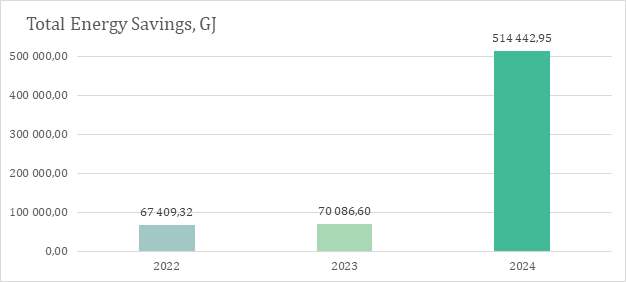
Since 2018, the Company has been consistently reducing its energy consumption. In 2024, energy savings amounted to 514 442.95 GJ of electricity in physical terms, which is seven times higher than the figures recorded in 2023.
Medium-Term Goals
To improve the energy efficiency of main gas transportation facilities, a comprehensive set of measures has been developed and approved for 2025 under the title "Organizational and Technical Measures for Electricity and Natural Gas Savings at the Production Facilities of JSC 'Uztransgaz' for 2025." Particular attention is given to the use of renewable energy sources.
The Company aims to reduce electricity consumption through the optimization of production processes, modernization and reconstruction of production technologies, and heating and cooling systems.
The gas transportation sector is among the most energy-intensive segments of the economy, involving the execution of complex and potentially hazardous operations, as well as constant interaction with the environment. In this context, the Company’s environmental priorities focus on the prevention and minimization of adverse environmental impacts, the rational use of natural resources, and the development and implementation of comprehensive measures to improve the ecological state both in the vicinity of and within Company facilities.
АО “Uztransgaz” operates and maintains gas transportation infrastructure comprising 13 642 km of trunk gas pipelines, 2 underground gas storage facilities, 20 compressor stations, and 420 gas distribution stations. The Company’s gas transportation network spans all regions of the Republic of Uzbekistan, each of which is home to unique fauna and flora and represents an essential part of Central Asia’s biodiversity. However, no gas transportation or underground gas storage facilities are located on or adjacent to protected natural areas.
АО “Uztransgaz” has developed an Environmental Protection and Rational Use of Natural Resources Action Plan for 2020–2025. This plan includes 133 measures with budget allocations for all Company subsidiaries across four main areas:
- water resources protection;
- atmospheric air protection;
- protection of land and mineral resources, waste management and processing;
- protection of flora and fauna.
The Company operates a procedure for the identification of environmental aspects, developed in accordance with the requirements of ISO 14001:2015, to define the process for identifying aspects, assessing impacts, and developing further mitigation actions, as well as for planning and managing these during interactions with third parties and across all Company business units, including 8 MGPMs and 2 UGSFs.
According to this procedure, each business unit head organizes work on identifying environmental aspects and controls the outcomes together with engineering and technical staff and other personnel. Environmental aspects refer to environmental risks. Identification of aspects and environmental impacts is carried out in several stages. First, business units identify the aspects and impacts related to input materials, resource use, results of interim operations, and final products, including the generation of all types of waste, atmospheric emissions, and water and soil discharges. Second, an assessment of environmental impact is performed by determining the significance of each aspect, measuring the likelihood of occurrence, and assessing the impact ranking.
All data from the identification of environmental aspects and impact assessments are recorded and stored within the respective business units. After identifying aspects and impacts, the assessment results are communicated to personnel via individual briefings, including explanations on the importance of meeting legislative and regulatory requirements and performing other risk control measures related to environmental aspects. Managers subsequently review the relevance of hazard identification and risk assessment at least annually.
When designing new facilities or upgrading existing ones, the Company conducts an environmental impact assessment, developing and implementing appropriate measures to prevent or mitigate potential negative effects.
The Company follows international environmental initiatives on reducing greenhouse gas emissions, implementing energy-saving technologies, and increasing the use of renewable energy. Environmental teams actively cooperate with the State Committee for Ecology of the Republic of Uzbekistan and other specialized organizations on environmental protection issues.
Currently, the Company’s environmental activities do not fully comply with International Finance Corporation (IFC) standards. However, the Company recognizes the importance of these international requirements as benchmarks for sustainable development and responsible natural resource management. Looking ahead, the Company intends to analyze existing practices and introduce higher standards of environmental management, including possible alignment with IFC principles, to enhance transparency, efficiency, and environmental responsibility.
The Company allocates significant funds to environmental protection activities. In 2024, total expenditures across the Company amounted to 2 242.5 million UZS.
| Indicator | 2022 | 2023 | 2024 |
|---|---|---|---|
| Expenditure on environmental protection measures, thousand UZS. | 2172662 | 2796876 | 2242529 |
A reduction in expenditures is envisaged by the action plan. At the same time, 535 100 000 UZS was allocated for greening activities, including the planting of fruit and ornamental seedlings, as part of initiatives in line with the Presidential Decree of the Republic of Uzbekistan No. UP–199 dated 23.11.2023 "On Measures to Ensure Environmental Sustainability by Further Increasing the Level of Greening in the Republic and the Consistent Implementation of the Nationwide Project 'Yashil Makon'."
In 2024, the following key activities were undertaken to contribute to environmental efforts:
- Greening of territories by planting flowers, fruit and ornamental seedlings;
- Signing contracts for the disposal of waste (automobile tires, fluorescent lamps, used oils, ferrous and non-ferrous scrap metal);
- Reducing atmospheric emissions of odorants in case of malfunctions at odorization facilities;
- Reducing the volume of gas vented during pipeline maintenance;
- Implementation of the "Program for the Modernization and Efficiency Enhancement of the Main Gas Transmission System of the Republic of Uzbekistan for 2021-2022";
- Strict monitoring of water consumption.
For 2025, the Company plans to launch the following initiatives to further develop and update its environmental practices:
- Development of an Environmental Program for Uztransgaz JSC;
- Environmental practices diagnostics as part of the Company's overall ESG diagnostics;
- Updating existing environmental protection policies;
- Development of Uztransgaz JSC’s Climate Strategy.
Land Resources
SASB EM-MD-160a.3
In order to minimize environmental impact and ensure the rational use of natural resources, the Company carries out land remediation activities in accordance with the requirements of the legislation of the Republic of Uzbekistan. These activities are performed by competent contractor organizations providing capital construction services for the Company’s facilities.
During the reporting period, land reclamation works were implemented in two regions of the Republic, demonstrating the Company’s systematic approach to environmental responsibility and sustainable development.
Formation and reclamation of contaminated lands by the Company in 2023–2024:
| Indicators | Unit of measurement | 2023 | 2024 |
|---|---|---|---|
| Land reclaimed during the reporting period | 7 | 36,3 | |
| Area of disturbed land in the current period | 13,4 | 7,4 | |
| Area of disturbed land at the end of the reporting period | 363,5 | 334,6 |
Direct greenhouse gas emissions (Scope 1)
Without reducing its obligations to deliver gas to consumers, the Company is committed to minimizing environmental risks during gas transportation and underground storage. Achieving environmental goals is supported by reducing the specific consumption of fuel and energy resources (FER) for own technological needs, reducing greenhouse gas emissions, and decreasing significant emissions.
Direct greenhouse gas emissions (Scope 1) from stationary sources at Uztransgaz JSC facilities occur during purging and venting of natural gas from pipelines and technological equipment, as well as due to leaks from flange connections of pipeline fittings. Methane, carbon dioxide, and nitrous oxide are released directly into the atmosphere. The fraction of CH₄ in the gas is up to 96%; CO₂ – 1%; N₂O – 0.5%.
The Company utilizes energy technology units: gas compressor units, boiler houses, heating furnaces, and fire regenerators. As a result of incomplete combustion of hydrocarbon fuel, methane and carbon dioxide are released into the atmosphere.
Indirect energy emissions (Scope 2) of the Company are attributed to the production of electricity purchased by the organization. Since the Company does not purchase but produces thermal energy using water-heating boilers that operate on fuel and technological gas, thermal energy is not included in Scope 2. The consumption of natural gas for the production of thermal energy is accounted for in Scope 1.
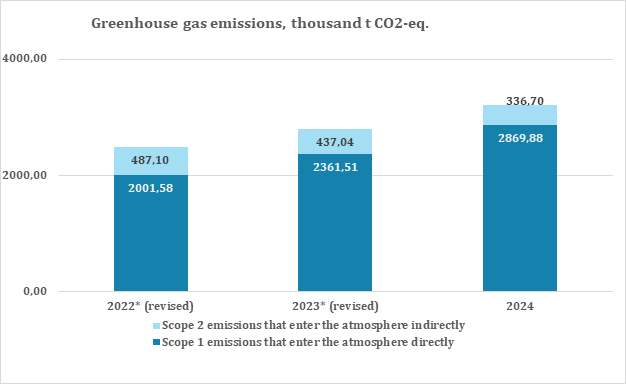
*Starting from the 2024 results, the volume of methane emissions data for the calculation of Scope 1 greenhouse gas emissions has been revised upwards to provide a more comprehensive representation of the Company’s environmental impact. For relevant comparison, the data from the 2023 and 2022 Sustainability Reports has been recalculated in accordance with the updated calculation methods for GRI 305-1 “Direct (Scope 1) GHG emissions.”
There are no ozone-depleting substances produced, nor any CO₂ emissions generated as a result of biomass combustion or decomposition at the Company’s facilities.
The baseline year for calculating greenhouse gas emissions at the Company was set as 2020 in accordance with Presidential Decree of the Republic of Uzbekistan No. PP-4388, clause 12, dated July 9, 2019. Regarding the consolidation method, emission statistics are reported for facilities directly controlled by the Company under ownership rights.
The increase in direct (Scope 1) emissions released into the atmosphere was due to large-scale repair works as part of the implementation of the “Program for the Modernization and Efficiency Enhancement of the Republic of Uzbekistan’s Main Gas Transportation System in 2021–2022.” During these activities, there was a temporary increase in the use of backup equipment and auxiliary machinery, which have higher levels of direct emissions. In addition, technical maintenance required short-term purging and relaunching of certain units, which also contributed to the increase in emissions during the reporting period.
The Company conducts an annual inventory and internal assessment of greenhouse gas emissions and other atmospheric emissions, identifying the most significant sources. In calculating emissions, the Company applies a Global Warming Potential (GWP) factor, which determines the radiative impact of one unit mass of methane relative to the corresponding unit of carbon dioxide over a specific period. In particular, the Company uses the following Global Warming Potential coefficients (Intergovernmental Panel on Climate Change, Fifth Assessment Report, 2014):
- Methane to CO₂-eq conversion factor: 28;
- Nitrous oxide to CO₂-eq conversion factor: 265.
The following methodologies are used for emissions calculations: RH39.0-140:2012 “Methodology for Calculating Pollutant Emissions for Oil and Gas Production and Processing Enterprises” by JSC "O’ZLITINEFTGAZ," and the 2006 IPCC Guidelines for National Greenhouse Gas Inventories.
АО “Uztransgaz” is committed to reducing greenhouse gas emissions by 10% by 2030 compared to the 2010 baseline and continues to enhance its adaptive capacity and reduce risks from adverse climate change impacts..
Plans for 2025
SASB EM-MD-110a.2
As of the end of 2024, the Company has not yet implemented a dedicated program for reducing direct greenhouse gas emissions (Scope 1). However, in 2025, the development of a Climate Strategy is planned as an important step toward sustainable development. This strategy will include specific measures aimed at reducing all types of emissions, including direct emissions. The Company recognizes its role in combating climate change and is committed to organizing its operations in a way that reduces environmental impact and contributes to the achievement of global climate goals.
Other Significant Air Emissions
GRI 305-7,416-1, SASB EM-MD-120a.1
In compliance with requirements for assessing the impact on public health and safety, AO “Uztransgaz” implements a comprehensive approach to environmental risk management. The Company deliberately does not conduct direct assessments of the impact of pollutant emissions on public health. This approach is driven by the need to prevent possible accidents and to minimize health risks associated with exposure to pollutants. The Company focuses on implementing preventive measures and strict emission controls to ensure the safety and protection of public health in the regions where it operates.
At the same time, when assessing the impact of AO “Uztransgaz” operations on ambient air quality, the Company analyzes the main sources and volumes of pollutant emissions in the vicinity of its facilities. Air pollution in the vicinity of the Company’s sites occurs due to emissions of eight elements into the atmosphere. The key category is a mixture of saturated hydrocarbons of the type CnH2n+2, accounting for 96% of total emissions. Saturated hydrocarbons are released into the atmosphere during technological purging of equipment and combustion of gas in process units.
Gas consumption for technological purging of equipment and for the operation of process units is accounted for as gas consumed for internal needs. In addition, operational losses at the Company’s facilities—such as leaks through flanged elements of shut-off valves and other equipment—are recorded. The norms for natural gas consumption for internal needs are determined by calculation, using industry-specific methods. The calculations are based on the technical passports of process equipment and the technological regulations for the operation of installations. Actual gas consumption for internal needs and operational losses is determined using the automated pipeline dispatch control system.
During the transportation of gas, the largest quantity of pollutants is released into the atmosphere, compared to underground gas storage, where the volume of pollutants amounts to only 1–2% of the total emissions.
When calculating pollutant emissions that have an impact on global warming, the methodology RH 39.0-140:2012 for oil and gas production and processing enterprises, developed by JSC “O'ZLITINEFTGAZ,” is used.
The main pollutants released by the Company into the atmosphere are nitrogen oxides (NOx), sulfur oxides (SOx), carbon monoxide (CO), particulate matter, volatile organic compounds (VOCs), as well as substances classified as first-class hazards. Currently, the Company does not monitor or record emissions of particulate matter with a diameter of 10 micrometers or less (PM10).
Atmospheric pollutant emissions in tonnes are presented below:
| Emissions | 2022 | 2023 | 2024 |
|---|---|---|---|
| Nitrogen oxide (NOx) | 2,837.28 | 2,706.46 | 3,030.66 |
| Sulfur oxide (SOx) | 26.36 | 22.17 | 2.25 |
| Emissions CO | 6584.49 | 4244.92 | 6210.71 |
| Volatile Organic Compounds (VOCs) | 96330.44 | 89441.37 | 80644.70 |
| Hazardous Air Pollutants | 0.85 | 1.18 | 1.23 |
| Emissions of Solid substances | 861.86 | 1170.71 | 1417.57 |
| Other emissions* | 370.19 | 393.23 | 379.19 |
| Total | 107011.47 | 97980.05 | 91686.30 |
Among the volatile organic compounds released into the atmosphere are methane, propane, and the odorant (TBM), which is added to the gas to provide a distinctive smell for timely leak detection and prevention. Hazardous air pollutants are represented by substances such as sulfur dioxide, nitrogen oxides, and hydrogen sulfide. Particulate matter includes emissions from metalworking, welding aerosols, and minor traces of inorganic dust. Persistent organic pollutants are not present at the facilities of JSC "Uztransgaz".
Expenditures and investments for environmental protection consist of the costs for general measures developed annually by each business entity of JSC "Uztransgaz," as well as expenses for the implementation of major projects. For example, one of the regularly implemented general measures is ensuring personnel readiness for the transportation of toxic cargo in order to manage the risk of air pollution when transporting hazardous substances. The main project continuing in 2024 is the "Program for the Modernization and Enhancement of Efficiency of the Republic of Uzbekistan’s Main Gas Transportation System for 2021–2022," which is expected to have a significant impact on mitigating the effects of climate change.
Water Resources
GRI 3-3, 303-1, 303-2, 303-3, 303-4
Uzbekistan is classified as a country with limited water resources. Approximately two-thirds of the Company’s gas transmission system facilities are located in areas with no water sources at all, particularly in the Kyzylkum Desert and the Ustyurt Plateau. Although gas transportation and underground storage are not water-intensive processes, these geographic and climatic conditions make effective water resource management one of the Company’s priorities.
Primarily, the Company uses water resources for domestic needs (including household and drinking water, and for filling fire-fighting systems). Water is used in relatively small volumes in production activities.
Water consumption is managed by the energy departments of the Company’s operating units. As of the reporting period, there is no special commission dedicated to water resource management. In carrying out its activities, the Company strictly complies with all requirements of the Law of the Republic of Uzbekistan “On Water and Water Use,” as well as the Company’s water consumption and wastewater discharge standards, and the sanitary rules and norms of the Republic of Uzbekistan No. 0318-15 “Hygienic and Anti-epidemic Requirements for the Protection of Water Bodies in the Territory of the Republic of Uzbekistan.”
Water consumption at the facilities of JSC “Uztransgaz” is sourced from surface, underground, and municipal sources. Surface water sources include the Raish Canal in the Andijan region and local canals in the Khorezm region, which are mainly used for irrigating agricultural lands. Underground sources are represented by artesian wells, and municipal sources by centralized water supply systems.
As part of its operations, the Company abstracts water in accordance with concluded agreements and permits for special water use. Based on calculations of required water consumption, the enterprise enters into an agreement with the relevant branch of the water supply authority – the State Unitary Enterprise “Suvokova.” The establishment of forecast values for water consumption indicators is based on requests from water resource management services, in accordance with consumption standards or based on actual consumption values from previous periods. The Company’s facilities do not have a significant impact on these water sources.
Industrial wastewater is discharged to the terrain, into evaporation ponds, or disposed of in underground horizons through specially equipped wells. Domestic wastewater is directed to septic tanks and sewage systems. No direct discharge of wastewater into surface water bodies is carried out.
In 2024, the volume of wastewater discharges amounted to 349.445 thousand cubic meters.
The breakdown of wastewater discharges by discharge site in thousand cubic meters is presented below:
| Indicator | 2022 | 2023 | 2024 |
|---|---|---|---|
| Planned total volume of water discharges | 796,205 | 607,937 | 627,017 |
| Actual total volume of water discharges, including: | 439,1655 | 433,3152 | 349,445 |
| relief terrain | 259,821 | 352,1902 | 265,445 |
| evaporation ponds | 54,911 | 37,863 | 26,225 |
| underground horizons | 15,312 | 15,051 | 20,647 |
| sewage systems | 101,485 | 22,891 | 14,436 |
| Septic tanks | 7,636 | 5,32 | 22,692 |
The 20% reduction in the volume of wastewater discharge is attributable to the transfer of certain non-production facilities of Urgenchtransgaz to the balance of the local khokimiyat, as well as the installation of water consumption meters at some MGPMs of Urgenchtransgaz, where previously water usage had been calculated based on regulatory documents.
In 2024, the main destination for water discharge was the terrain (land surface), accounting for 76% of the total wastewater discharge volume. This is explained by the increased amount of land requiring irrigation following the planting of tree saplings for landscaping and to improve resilience against sand and dust storms.
Over the past three years, all discharged water in regions experiencing water stress consisted exclusively of fresh water, as presented in the following table (in thousand cubic meters).
| Indicator | 2022 | 2023 | 2024 |
|---|---|---|---|
| Total water discharge, including: | 439.1655 | 433.3152 | 349.55 |
| fresh water | 439.1655 | 433.3152 | 349.55 |
| other water | 0 | 0 | 0 |
In the process of water discharge, the Company is guided by the sanitary rules and regulations of the Republic of Uzbekistan No. 0318-15 “Hygienic and anti-epidemic requirements for water protection and water bodies in the territory of the Republic of Uzbekistan”, which define the discharge conditions and the required quality of discharged water. Over the past three years, the Company has not exceeded the established limits for water disposal volumes.
The priority substances of concern for which the treatment of wastewater is carried out are petroleum products. The country has a unified approach for setting discharge limits for priority substances of concern. This approach has been developed in accordance with the Resolution of the Cabinet of Ministers No. 14 "Regulation on the procedure for developing and approving environmental standardization projects" dated January 21, 2014. Table 1 of Appendix 4 provides the permissible concentration for each substance of concern.
The Company is committed to responsible water resource management and strives to reduce water consumption through strict monitoring and prevention of leaks. For the purpose of assessing environmental impact, regular monitoring of the quality of underground, surface, and municipal water is carried out, including laboratory analyses and monitoring of treatment efficiency. At the beginning of each year, all structural units approve a set of measures aimed at effective water resource management and environmental safety.
In accordance with the Cabinet of Ministers Resolution No. 14 dated January 21, 2014 "Regulation on the procedure for developing and approving environmental standardization projects", every three years, an inventory of water consumption and discharge sources is conducted. In addition, an annual assessment of the effectiveness of the Company’s environmental activities is carried out, which includes an analysis of the sections "Water" and "Discharges and Waste", based on the collection and processing of initial data, as well as visual inspection of facilities.
Recognizing the importance of effective water resource management, in 2025 the Company plans to further reduce water consumption by increasing the share of air-cooling of equipment. In addition, the implementation of the "Program for Modernization and Efficiency Improvement of the Republic of Uzbekistan’s Main Gas Transmission System for 2021-2022", which continued in 2024, will help achieve the Company’s targeted goals in water resource management in the short term.
Waste Generation
GRI 3-3, 306-1, 306-2, 306-3
JSC “Uztransgaz” conducts its operations with an awareness of the waste generated during its business activities. To prevent negative environmental impacts, the Company systematically plans and implements measures aimed at minimizing waste generation at production sites, as well as ensures the transfer of waste to licensed organizations for safe disposal and recycling.
According to the legislation of the Republic of Uzbekistan, waste hazard levels are classified into five classes. During gas transportation and underground storage in UGSF, waste of all five hazard classes is generated, with non-toxic waste of the 5th hazard class prevailing. In particular, during transportation, waste is generated from the transit of natural gas from Turkmenistan and Kazakhstan. Additionally, an increase in the number of repair works and reconstruction of the linear part of trunk gas pipelines led to intensive waste generation, resulting in significant amounts of ferrous and non-ferrous scrap. A substantial portion of the waste is also comprised of used turbine oils, which belong to the 2nd hazard class and are generated during oil replacement at compressor stations.
In 2024, the total volume of generated waste amounted to 9 586.99 tonnes, representing an increase of 13.8% compared to the previous year.
The volume of generated waste by hazard class, in tonnes, is presented below::
| Generated waste | 2022 | 2023 | 2024 |
|---|---|---|---|
| Generated toxic waste, including in tons | 4,467.43 | 3,673.25 | 5,948.40 |
| 1 hazard class | 6.48 | 9.02 | 8.27 |
| 2 class hazard | 111.97 | 324.03 | 342.68 |
| 3 hazard class | 27.01 | 46.43 | 742.53 |
| 4 hazard class | 4,321.96 | 3,293.77 | 4,854.92 |
| Generated non-toxic waste (5 hazard class), ton | 3,679.35 | 4 746.73 | 3,638.59 |
| Total volume of generated waste, ton | 8,146.78 | 8,419.98 | 9,586.99 |
Generated waste is transferred to specialized licensed organizations for disposal and treatment. The majority of waste generated by Uztransgaz JSC is classified as low-hazard or practically non-hazardous—primarily ferrous and non-ferrous metal scrap, which is sent for remelting in accordance with the Resolution of the Cabinet of Ministers of the Republic of Uzbekistan No. 425 "On measures to improve the procedure for handling scrap and waste of non-ferrous and ferrous metals" dated July 6, 2018.
Additionally, waste of the 2nd hazard class—used turbine oils—is sent for regeneration according to the Resolution of the Cabinet of Ministers of the Republic of Uzbekistan No. 258 "On approval of the regulations on the procedure for delivery, collection, settlements, storage and transportation of used technical oils" dated September 4, 2012. These regulations govern the entire cycle of waste management, from collection and sorting to transfer for further disposal, treatment, or recycling.
The Company maintains a responsible approach to monitoring waste management procedures. Collection and monitoring of waste data, as well as identification of the most significant sources of waste, are carried out on a regular basis by the environmental officer of the executive office and relevant structural units. The processes used for waste data collection and monitoring include:
- conducting an inventory of waste generation and disposal once every five years;
- compiling a unified quarterly statistical report (Form 1-EKO);
- preparing a quarterly calculation of compensation payments for environmental pollution and waste disposal via the EcoFund platform.
Plans for 2025 to reduce the volume of generated waste include the continued implementation of the modernization program of the Republic of Uzbekistan’s gas transmission system, which will have a positive impact on achieving the Company’s waste reduction targets..
Compliance with Environmental Legislation Requirements
GRI 3-3, 2-27
A key priority for Uztransgaz JSC is the strict adherence to environmental legislation requirements, given the significant impact of the Company’s production activities on the environment and the necessity to minimize such effects. The Company is committed to carrying out its production activities in full compliance with the legislation of the Republic of Uzbekistan and takes all necessary measures to prevent negative environmental impacts. As part of these efforts, both internal and external environmental impact assessments are conducted annually, including the monitoring of the environmental management system and verification of compliance with environmental regulations.
All Company’s structural units within the scope of the Integrated Management System (IMS) comply with environmental legislation requirements and conduct their activities in accordance with international standards for quality management, environmental management, occupational health and safety management, and energy management systems. The compliance management for environmental legislation and international standards is carried out by environmental engineers and the Health and Safety Department, with overall supervision by the standing IMS committee.
The Company has implemented a procedure for the identification of environmental aspects, which enables the organization to understand the impact of its operations on the environment and supports ongoing performance improvement. This procedure takes into account both routine and non-standard situations, including emergencies of both technological and natural origin. It covers monitoring of all impacts related to input materials, resources used (electricity, gas, fuel, water, etc.), intermediate operations, final products, as well as the generation of all types of waste and emissions.
Following the identification of environmental aspects and impacts, a Register of Significant Environmental Impacts is compiled based on the assessment results and is updated at least annually. The results of the assessment are communicated to staff, and personnel are familiarized with the work performed and the necessity to comply with legislative and regulatory requirements.
In 2024, there were no recorded cases of violations of the Law “On Environmental Protection of the Republic of Uzbekistan” or the requirements of international standards ISO 14001:2015 (Environmental Management System), ISO 50001:2018 (Energy Management System), or ISO 45001:2018 (Occupational Health and Safety Management System).
In the long term, the Executive Office and all structural units of the Company are committed to continuing efforts to identify any non-compliance with the environmental legislation of the Republic of Uzbekistan, to identify aspects and manage risks, and to implement measures for the prevention of any non-compliance with environmental legislation requirements.