
About the Company
JSC Uztransgaz is the national operator of the gas transmission system of the Republic of Uzbekistan, ensuring the reliable and uninterrupted supply of natural gas to consumers throughout the country. The Company also manages gas storage and transit operations, playing a key role in the region’s energy security. Through its activities, the organization makes a substantial contribution to sustainable development by supplying strategically important enterprises and sectors of the economy with a more environmentally friendly type of fuel — natural gas. Thanks to the operations of JSC Uztransgaz, millions of households in Uzbekistan have stable access to heating, electricity, and comfortable living conditions.
The core functions of JSC Uztransgaz — the transportation and transit of natural gas — are defined by Presidential Decree No. PP-280 dated June 15, 2022, “On Additional Measures for Reforming the Natural Gas Market.”
The Company holds the status of a natural monopoly in the pipeline transportation of natural gas. As such, its operations are regulated by the Law of the Republic of Uzbekistan “On Natural Monopolies.”
As of December 31, 2024, the Company’s authorized capital consisted of 625 777 072 registered shares with a nominal value of 1 000 UZS each. On March 29, 2024, the Ministry of Economy and Finance of the Republic of Uzbekistan transferred 292 785 159 registered shares to JSC Uzbekneftegaz. As a result, 52.70% of JSC Uztransgaz shares are owned by the Ministry of Economy and Finance of the Republic of Uzbekistan, the central executive body within the Cabinet of Ministers responsible for financial governance and intersectoral coordination. Another 46.78% of the Company’s shares are held by the Joint Stock Company Uzbekneftegaz. The remaining 0.50% of shares are distributed among employees of industry enterprises and organizations, as well as other individuals and legal entities.
Natural Gas Trading Scheme in 2024
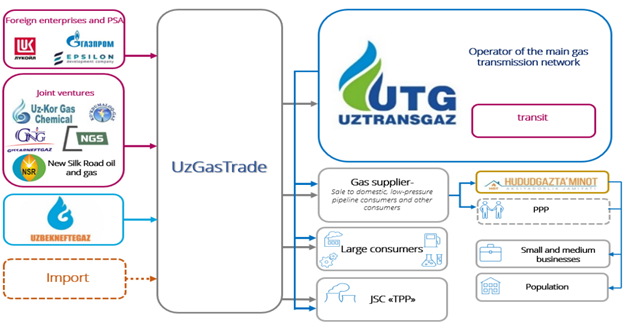
As the sole operator, the Company provides natural gas transportation services. The transportation tariff is developed by the Price Regulation Authority under the Ministry of Finance and approved by the Cabinet of Ministers of the Republic of Uzbekistan.
The total volume of gas transported in 2024 amounted to 37.39 billion cubic meters.
| Years | Event Description |
|---|---|
| 1962 | Start of development of the gas field, including the transfer of pipelines from Bukhara – Ural and Central Asia – Center. |
| 1973 | Establishment of the production association "Uzbekgazsanoat"; JSC Uztransgaz began evolving as an independent gas transportation company. |
| 1978 | Launch of experimental underground storage, followed by commissioning of the gas storage facility at the Gazli gas field the next year. |
| 1992 | In accordance with Resolution No. 585 of the Cabinet of Ministers of the Republic of Uzbekistan dated December 23, 1992, the State Joint Stock Company Uztransgaz was established on the basis of specialized divisions of the Uzbekgazsanoat production association, as part of the National Oil Company Uzbekneftegaz. |
| 1999 | According to Resolution No. 169 of the Cabinet of Ministers dated April 30, 1996, experimental use of the Khoiobid CNG station began based on the well-developed capacity of the Khoibod oil and gas field. Presidential Decree No. UP-2154 dated December 11, 1998, and Resolution of the Cabinet of Ministers dated December 15, 1998, established JSC Uztransgaz as an open joint-stock company with legal entity rights. |
| 2006 | Pursuant to Presidential Decree No. 4388 dated August 8, 2006, “On Measures to Improve the Organizational Activities of JSC Uztransgaz” and to form a unified policy for the development and use of gas distribution networks, an effective system was created for managing gas transportation and sales, along with the rational use of gas infrastructure. The reorganization included the transfer of gas supply enterprises from the Uzbek agency Uzkommunkhizmat to JSC Uztransgaz and the formation of six interregional enterprises. |
| 2009 | Completion and commissioning of the unique 165-kilometer Akhangaran–Pungan main gas pipeline with the Akhangaran compressor station through the Kamchik pass, delivering gas to the Fergana Valley. The pipeline crosses the slopes of the Kyura mountains. |
| 2019 | In 2019, JSC Uztransgaz was separated from JSC Uzbekneftegaz in accordance with Presidential Decree No. 4388 dated July 9, 2019. The share of JSC Uzbekneftegaz in the authorized capital of Uztransgaz was transferred to the State Asset Management Agency. That year also saw the establishment of JSC Hududgazta'minot based on Uztransgaz’s regional gas supply branches, with the State Asset Management Agency appointed as its state shareholder. |
| 2020 | According to Presidential Decree No. 6096 dated October 27, 2020, “On Accelerated Reform of State-Owned Enterprises and Privatization of State Assets,” the Ministry of Finance of the Republic of Uzbekistan became the primary shareholder of JSC Uztransgaz (under order No. N60/20 dated December 14, 2020). |
| 2022 | Presidential Resolution No. PP-280 dated June 15, 2022, “On Additional Measures for Reforming the Natural Gas Market,” transferred the functions of purchasing natural gas from producers and selling it to consumers connected to the main gas transmission system from JSC Uztransgaz to JSC UzGasTrade. |
| 2024 | On March 29, 2024, the Ministry of Economy and Finance of the Republic of Uzbekistan transferred 292 785 159 (46.8% of the total number of shares) registered shares to JSC Uzbekneftegaz. |
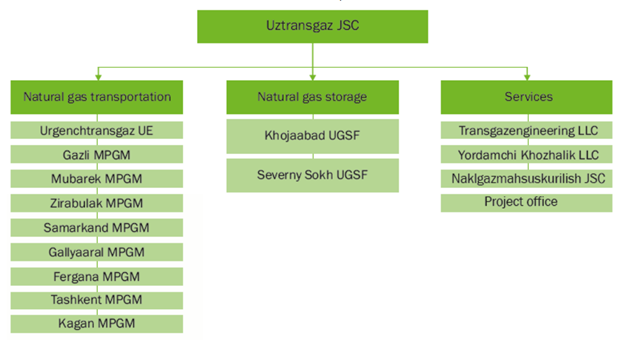
Company Structure
The structure of JSC Uztransgaz includes 9 enterprises responsible for natural gas transportation, 2 enterprises for gas storage, and 3 service units specializing in construction and mixed agriculture. Additionally, the Company includes a Project Office tasked with implementing corporate and digital transformation initiatives. The management of structural divisions is carried out from 7 regions of the Republic of Uzbekistan and the city of Tashkent.
The Company’s Executive Office combines the functions of a central administrative body and oversees direct management of production operations.
The directly subordinate structural divisions and affiliated entities are listed below:
According to Presidential Resolution No. PP-280 “On Additional Measures for Reforming the Natural Gas Market,” starting from August 1, 2022, the functions of purchasing natural gas from producers and selling it to consumers connected to the trunk gas transmission system through direct contracts were transferred from JSC Uztransgaz to JSC UzGasTrade.
Thus, during the 2024 calendar year, the Company was fully engaged in the following types of activities:
- Transportation of natural gas to large industrial enterprises, thermal power plants, and suppliers that provide gas to low-pressure household consumers;
- Transit of natural gas;
- Injection of natural gas into underground storage facilities.
The primary customer of JSC Uztransgaz's services is JSC UzGasTrade. However, due to the specifics of Uzbekistan’s gas transmission system, the qualitative and quantitative process of receiving and delivering natural gas from producers to consumers closely links the Company’s operations with the following natural gas suppliers:
| Natural Gas Suppliers | |
|---|---|
| JSC Uzbekneftegaz | JV LLC Gissarneftegaz |
| LLC Shurtan Gas Chemical Complex | JV LLC Natural Gas-Stream |
| LUKOIL Overseas Supply and Trading LTD | JV LLC Uz-Kor Gas Chemical |
| JV Kokdumalakgaz | Imported natural gas suppliers |
The Company is also responsible for ensuring the high-quality delivery of natural gas to key consumers, such as:
| Natural Gas Consumers | |
|---|---|
| JSC “Hududgazta'minot”, including: | Large industrial consumers |
|
JSC “TPP” (Thermal Power Plants) |
| Date | Event Description |
|---|---|
| March |
Change in Shareholding Structure On March 29, 2024, the Ministry of Economy and Finance of the Republic of Uzbekistan transferred 292,785,159 registered shares (46.8% of the total number of shares) to JSC Uzbekneftegaz. |
| June |
Report Publication In accordance with Clause 23 of Presidential Decree No. UP-37 dated February 21, 2024, “On the State Program for the Implementation of the Strategy ‘Uzbekistan – 2030’ in the Year of Support for Youth and Business,” JSC Uztransgaz published its Corporate Social Responsibility Report for 2023. |
| July |
Personnel Changes By resolution of the Extraordinary General Meeting of Shareholders held on July 12, 2024, new members of the Supervisory Board were elected, including two independent members. |
| August |
Annual General Meeting On August 7, 2024, the Annual General Meeting of Shareholders was held, where 12 key issues were reviewed. The organizational structure of JSC Uztransgaz was approved. |
| September |
Personnel Changes A new Deputy Chairman of the Management Board for Construction and Transport was appointed. |
| November |
Report Publication The verified ESG Report on Sustainable Development of JSC Uztransgaz for 2023 was released. |
| November |
Personnel Changes A new member of the Supervisory Board was appointed by decision of the Extraordinary General Meeting of Shareholders. |
Mission of JSC Uztransgaz
JSC Uztransgaz sees its mission as ensuring the reliable, safe, and uninterrupted transportation of natural gas to the domestic market of the Republic of Uzbekistan, thereby fulfilling a vital social function — supplying the population and strategic sectors of the economy with essential energy resources.
The Company actively contributes to strengthening both national and regional energy security, recognizing its responsibility for the stable operation of the gas transmission infrastructure. The development of the country’s transit potential and integration into regional energy chains are considered important components of sustainable growth, enhancing Uzbekistan’s energy resilience and economic stability.
JSC Uztransgaz acknowledges its role in achieving the Sustainable Development Goals (SDGs) and strives to balance economic efficiency, social responsibility, and the rational use of natural resources.
Company Vision
JSC Uztransgaz is a responsible participant in the fuel and energy sector and holds the status of a natural monopoly in the field of natural gas transportation. The Company’s objectives include not only efficient management of the existing gas transmission infrastructure but also the progressive technological and production development aligned with long-term national priorities.
Guided by the principles of sustainable development, the Company seeks to build a more flexible, reliable, and environmentally oriented gas supply system. Its areas of focus include equipment modernization, digitalization of production processes, improvements in energy efficiency, and the integration of advanced technical solutions to minimize environmental impacts.
JSC Uztransgaz is committed to shaping a modern, sustainable, and technologically advanced gas transmission network capable of effectively responding to evolving challenges, supporting the country's energy stability, and contributing to the long-term development of both the economy and society.
Company Operations
JSC Uztransgaz carries out the transportation of natural gas through trunk pipelines, supplying energy to industry, the utilities sector, and the population. The Company plays a crucial role in maintaining energy stability and holds strategic importance for Uzbekistan’s economic development. The Company’s operations directly affect the interests of the state, businesses, international partners, and citizens, obligating Uztransgaz to uphold high standards of responsibility and operational sustainability.
At present, the Company is guided by the "Concept for Ensuring the Republic of Uzbekistan with Oil and Gas Products for 2020–2030," developed by the Ministry of Energy of the Republic of Uzbekistan. This document aims to ensure the balanced development of the oil and gas sector within a unified fuel and energy complex. It outlines the goals and objectives for the medium- and long-term development of the sector, key priorities and directions, as well as the mechanisms for ensuring effective state energy policy implementation at various stages — all geared toward achieving the planned targets.
The Company has identified the following strategic directions:
| Titles of Strategic Directions |
|---|
| Stable supply of natural gas to consumers both within the Republic of Uzbekistan and abroad, in accordance with the terms of concluded contracts |
| Attraction and implementation of investment projects aimed at expanding the gas transmission system and monitoring existing trunk gas pipeline facilities |
| Rational use of fuel and energy resources within gas transmission and gas distribution systems through the introduction of modern technologies that reduce energy intensity and enhance production energy efficiency |
The Company has defined the following priority objectives based on its strategic goals:
| Objective Title | Work Carried Out in 2024 |
|---|---|
| Modernization and reconstruction of the existing gas transmission system; development of transit potential |
In accordance with the Program for Modernization and Efficiency Improvement of the Republic of Uzbekistan’s Trunk Gas Transmission System for 2021–2022, activities were planned and implemented for the reconstruction, construction, and repair of main gas pipelines with a total length of 47.4 km. The following sections were completed and commissioned after reconstruction: - Commissioning of the “CAC-II” (Central Asia – Center II) main gas pipeline with a diameter of 1 220 mm; - Completion of line welding on the Yangiyer–Akhangaran main gas pipeline: 47.4 km. *- The actual length of the constructed gas pipelines may vary from the projected length. |
| Publication of reports in accordance with International Financial Reporting Standards (IFRS) and the Global Reporting Initiative (GRI) |
1. Consolidated financial statements for 2023 were prepared in accordance with IFRS, and an unqualified audit opinion was obtained for the 2022 reporting period. 2. The ESG Report on Sustainable Development of JSC Uztransgaz for 2023 was prepared in line with GRI Standards. A positive opinion was issued following the independent verification of the 2023 ESG Report. 3. A Corporate Social Responsibility Report was compiled in accordance with Presidential Decree No. UP-37 “On the State Program for the Implementation of the Strategy ‘Uzbekistan — 2030’”. 4. All the above-mentioned reports were published on the Company’s official website. |
| Enhancement of digital operational efficiency and implementation of IT in the Company’s technological and management processes |
• Successfully deployed the Automated Dispatch Control System (ADCS). • Implemented the Automated System for Monitoring, Accounting, and Control of Energy Resources and Technological Processes (ASMACEP), improving transparency and real-time data capture for energy consumption and operational metrics. |
JSC Uztransgaz recognizes the importance of its impact on the economy, environment, and society, aiming to enhance long-term value while ensuring its sustainable development in the interests of all stakeholders. The Company is committed to aligning its economic, environmental, and social objectives to support long-term sustainable growth.
The sustainability management system at JSC Uztransgaz is integrated into the corporate structure and is based on a comprehensive approach to Environmental, Social, and Governance (ESG) aspects. Coordination of related processes is carried out by the Project Office, which reports directly to the First Deputy Chairman of the Management Board for Transformation.
The activities of the Project Office are governed by the Company’s internal regulatory documents as well as by the legislative and regulatory acts of the Republic of Uzbekistan.
In 2024, a key vector for sustainability was defined by the shareholder’s position, as reflected in the approved “Shareholder Expectations” action plan. Under this plan, the Company launched and implemented various initiatives across environmental, social, and corporate domains to build the foundation for sustainable growth and improve corporate governance effectiveness.
The Executive Body of the Company is the initiator of the annual sustainability reporting cycle and serves as a guarantor of the accuracy and completeness of the disclosed information. The report preparation process includes internal review and coordination, and final approval is granted by order of the Chairman of the Management Board. The approved report also outlines the Company’s priority areas for future sustainability-related actions.
Reports on occupational health and safety, industrial safety, and environmental protection are submitted to the heads of structural divisions at least once a year. These reports form the basis for identifying and analyzing all impact aspects, verifying the accuracy of their assessments, and determining necessary environmental management measures.
Contribution to the UN Sustainable Development Goals
JSC Uztransgaz supports the United Nations (UN) initiative on sustainable development and is committed to contributing to the achievement of selected Sustainable Development Goals (SDGs) through responsible business conduct, minimizing environmental impact, applying best practices in corporate governance, and effective human resource management.
Recognizing the importance of all 17 UN SDGs aimed at addressing critical economic, social, and environmental issues, the Company has identified six priority goals in the areas of environmental protection and occupational health and safety. These were selected in line with the Resolution of the Cabinet of Ministers of the Republic of Uzbekistan No. 83 dated February 21, 2022, “On Additional Measures to Accelerate the Implementation of National Sustainable Development Goals and Objectives until 2030.”
The Company integrates the following SDGs into its operations:
 Title of UN Sustainable Development Goal (SDG) Title of UN Sustainable Development Goal (SDG)
|
|---|
| 3.Ensure healthy lives and promote well-being for all at all ages |
| 6. Ensure availability and sustainable management of water and sanitation for all |
| 7. Ensure access to affordable, reliable, sustainable, and modern energy for all |
| 8. Promote sustained, inclusive and sustainable economic growth, full and productive employment and decent work for all |
| 12. Ensure sustainable consumption and production patterns |
| 13. Take urgent action to combat climate change and its impacts |
Company Results in 2024
|
|
Achievements of JSC Uztransgaz |
|---|---|

|
3. Ensure healthy lives and promote well-being for all at all ages 6730 employees underwent annual medical examinations 971,5 million UZS allocated for medical and preventive care activities |

|
6. Ensure availability and sustainable management of water and sanitation for all: Water consumption reduced by 4,2% ompared to the previous reporting period through water-saving initiatives Volume of water discharge reduced by20% ompared to the previous reporting period due to the installation of meters and the transfer of non-core facilities |

|
8. Promote sustained, inclusive and sustainable economic growth, full and productive employment and decent work for all: 2334 ompany employees completed various upskilling and professional training programs Social benefits and allowances increased by 40% compared to the previous period |

|
12. Ensure sustainable consumption and production patterns: Total installed capacity of solar photovoltaic stations increased by more than 20% compared to the previous period Renewable energy generation increased bу 50% compared to the previous period |
Sustainability Management Plans for 2025
In 2025, JSC Uztransgaz plans to strengthen its sustainability management system by conducting a comprehensive diagnostic assessment of its current ESG practices. This will help identify areas for improvement in line with international standards. Based on the results of the assessment, the Company will develop a set of new corporate policies and programs that reflect its commitment to the principles of sustainable development.
One of the key focus areas will be the development of a Climate Strategy aimed at reducing the carbon footprint, improving energy efficiency, and adapting to climate-related risks
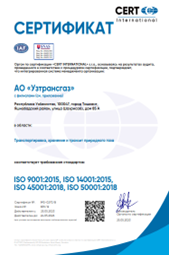
To ensure a proper level of oversight and sustainable development, JSC Uztransgaz has implemented and operates an Integrated Management System (IMS). The IMS certificate is valid from May 25, 2023 to May 24, 2026. The Company's approach to managing economic, environmental, and social aspects is grounded in a commitment to international best practices.
The Integrated Management System Policy defines the core priorities and values the Company adheres to in relation to its customers, employees, and all other stakeholders. It also outlines the strategic directions for the IMS, which includes quality management, environmental management, occupational health and safety management, and energy management. The key focus areas of the IMS Policy include:
● Maximizing customer satisfaction by ensuring natural gas transportation for domestic and export markets, and transit;
● Creating safe working conditions and preventing workplace injuries and occupational diseases;
● Preventing the negative impact of the Company’s operations on the environment;
● Increasing energy efficiency through the introduction and use of energy-saving technologies.
The IMS is an integral part of the Company’s management system and complies with the following international standards::
- ISO 9001 :2015 – Quality Management System;
- ISO 14001:2015 – Environmental Management System;
- ISO 45001:2018 – Occupational Health and Safety Management System;
- ISO 50001:2018 – Energy Management System.
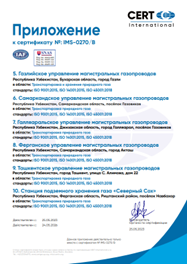
As of the reporting period, 10 structural divisions and entities within the Company were certified in all IMS areas. The enterprise “Urganchtransgaz” is certified only for ISO 9001:2015 – Quality Management System.
The compliance of most of the Company’s enterprises with standards in quality, environmental, occupational health and safety, and energy management demonstrates that the management system and both internal and external processes meet globally recognized standards.
The implementation of IMS requirements is the responsibility of the Company’s management, department heads, all employees, the Technical Policy Department of the Executive Office, and internal IMS auditors.
To support management under IMS, the Company has developed and implemented the following procedures:
- Documented information management
- Internal audit management
- Non-conformance and corrective actions management
- Infrastructure management
- Hazard identification and risk assessment
- Personnel management
- Environmental aspect identification
- Contractor interaction
- Emergency preparedness
- Energy planning and energy performance analysis.
The Company pays special attention to continuously improving the IMS. Each year, departments and divisions set goals and measures, which are approved by the Chairman of the Management Board. In addition, the effectiveness of the IMS is analyzed annually in accordance with international standards. The analysis is based on data provided by all divisions, consolidated by the Technical Policy Department, the Department for Occupational Safety and Industrial Security, and the Energy Department. The results and proposed improvements are submitted to the Company’s management for decision-making. Approved decisions are included in the IMS goals and action plans.
An internal IMS audit is conducted annually. These audits are carried out by internal auditors selected from members of standing commissions in the Executive Office and structural divisions, along with consultants from a contracted management systems consultancy. The commissions operate under internal Company orders and in accordance with the IMS Internal Audit Management Procedure.
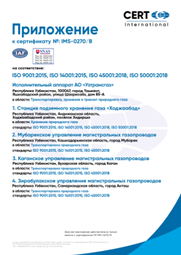
The Company cooperates with the international certification body “CERT International” to assess the compliance of its IMS with ISO standards. From May 13 to 17, 2024, JSC Uztransgaz underwent its first surveillance audit to assess compliance with ISO 9001:2015, ISO 14001:2015, ISO 45001:2018, and ISO 50001:2018.
The audit identified two major and three minor non-conformities, along with five recommendations. All non-conformities were resolved prior to the final audit report from the certification body. Corrective actions were taken, and an action plan was developed to address the root causes and implement the auditors’ recommendations.
As a result of the first surveillance audit, based on document reviews and field assessments at the Company’s production units, CERT International concluded that the management system is effective and compliant with international standards, and issued the corresponding certificates.
The IMS certificates and annex detailing compliance with ISO 9001:2015, ISO 14001:2015, ISO 45001:2018, and ISO 50001:2018 are presented below:
Occupational Health, Industrial Safety, and Environmental Management System
At JSC Uztransgaz, the management system for occupational health, industrial safety, and environmental protection is developed based on best international practices and complies with the following standards: ISO 14001 and ISO 45001. The effectiveness of the management systems is regularly confirmed through external audits.
In accordance with the requirements of ISO 14001:2015 Environmental Management Systems, all structural divisions of the Company covered by the Integrated Management System (IMS), as well as external organizations interacting directly with the Company, apply the environmental management system to identify environmental impacts and plan appropriate control measures.
At the enterprise level, environmental safety is managed by environmental engineers, with overall oversight provided by the Department for Occupational Health and Industrial Safety.
Reports on occupational health, industrial safety, and environmental protection are submitted to division heads at least once a year. These reports include identification and analysis of all impact aspects, assessment accuracy, and determination of necessary environmental management measures.
The Company is confidently advancing toward the achievement of its goals related to compliance with international standards across all relevant domains. In 2025, the main areas of work to improve the IMS, in addition to maintaining full compliance with applicable standards, include:
- Creating safe working conditions, preventing injuries and occupational diseases related to the Company’s operations.
- Preventing the negative environmental impacts of the Company’s activities.
- Improving energy efficiency through the implementation and use of energy-saving technologies.
For each of the areas above, a set of organizational and technical measures has been defined, along with the necessary resources, timelines, and persons responsible for execution and control..